
Durant sits on ground that never stops moving.
Bryan County gets some of the heaviest rainfall in Oklahoma, around 44 inches a year, more than Oklahoma City and well above the state as a whole. Then summer arrives, temperatures push past 100 degrees, and the same clay that swallowed all that spring rain starts giving it back. The soil swells, then shrinks. Every year. Under every foundation in the county.
That cycle is why foundation settlement tops the repair calls Pierman gets from Durant, and why homes here tend to show the same patterns of damage after the same kinds of seasons. This article walks through what happens under a Bryan County home from spring to fall, what that movement does to the structure above it, and when the damage crosses the line from watch-it to fix-it.
What You Need to Know
- Bryan County receives around 44 inches of rain per year, among the highest totals in Oklahoma, and most of it lands between April and June.
- The clay soil under Durant absorbs that water slowly and holds it for weeks, then loses it fast when summer heat arrives.
- Settlement happens when that shrink cycle creates voids under the foundation, and the house drops into them unevenly.
- The damage shows up inside first: doors, floors, and wall cracks. Outside signs come later.
- Piers driven below the active clay layer take the seasonal cycle out of the equation entirely.
Spring: The Ground Fills Up
Spring in Bryan County is generous with water. April, May, and June bring the heaviest stretch of the year, and the clay under Durant takes it in the way clay does: slowly, and without letting go. The USDA classifies most of the soil in this part of Oklahoma as Hydrologic Group D, the slowest-draining category there is. Water that lands in a Durant yard in May can still be sitting in the soil in late June.
As the clay absorbs water, it expands. Not by a little. Expansive clay in this region can swell enough to lift a foundation measurably during a wet spring. Lots with poor drainage make it worse: water that pools near the house pushes the soil beneath the foundation to swell more than the soil ten feet away, so the ground under the home rises unevenly.
Most homeowners notice nothing during this phase. The doors work. Floors feel normal. The damage being set up right now will not show its face until the water leaves. How much rain does it take? One saturated spring is enough to load the cycle.
Summer: The Ground Lets Go
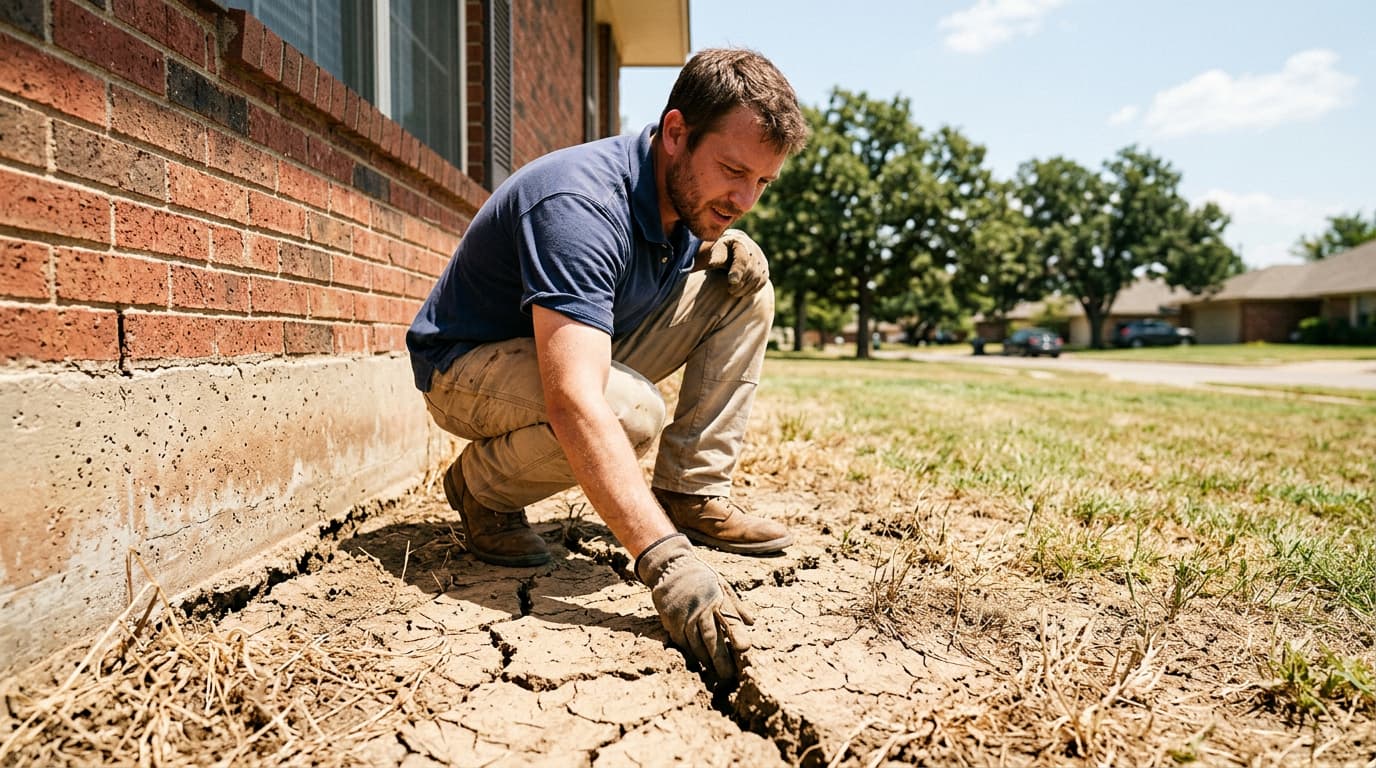
July and August in Durant regularly clear 100 degrees. The clay that spent spring absorbing water spends summer losing it, and it shrinks as it dries. This is the half of the cycle that does the real damage. When clay contracts, it pulls away from whatever it was touching, including the underside of your foundation.
The gaps that form are called voids, and they are exactly what they sound like: sections of foundation with nothing under them. Concrete is strong under compression but weak without support. A slab or footing bridging a void carries load it was never designed to carry alone, and something eventually gives. A corner drops. A section of slab cracks and settles. One side of the house ends up lower than the other.
Trees accelerate all of it. A mature oak or elm within 30 to 40 feet of a foundation pulls hundreds of gallons of water from the soil in a dry month, drying the clay on that side of the house faster than anywhere else. In older Durant neighborhoods with big established trees, the settlement pattern often points straight at the nearest one.
This is the season when Pierman’s phone rings most from Bryan County. Not because homeowners see the soil moving, but because the house starts talking: a door that will not latch, a crack over a window that was not there in June.
Fall: The Cycle Resets, but the House Does Not
Fall rains rehydrate the clay, and the soil swells back toward where it started. Here is the part that surprises homeowners: the foundation does not ride back up with it. A house that settled into summer voids has found a new resting position. When the soil expands again, it pushes unevenly against a structure that already moved, adding new stress in new directions.
Each full cycle can leave the foundation slightly further from level than the year before. One year is invisible. Ten years is a sticking door. Thirty years is a floor you can see sloping from the doorway and a foundation repair conversation that could have been much smaller a decade earlier.
Durant’s housing stock makes this compounding visible. Homes near downtown and in the older neighborhoods around Southeastern Oklahoma State University have been through 50, 60, and 70 of these cycles. The newer construction on the edges of town is earlier in the count, but it is sitting on the same clay, running the same clock.
What Settlement Looks Like From Inside a Durant Home
The structure telegraphs what the soil is doing. These are the signs Bryan County homeowners report again and again, roughly in the order they tend to appear.
Doors that stick or stop latching. Usually first, usually on the side of the house closest to the settlement. One door could be summer humidity swelling the wood. Two or three in the same area, at the end of a dry summer, is the foundation.
Diagonal cracks from window and door corners. The frame racks as the foundation drops, and drywall cracks along the stress line. Hairline and stable for years is cosmetic. New, growing, or wider than a quarter inch deserves a look.
Floors that slope toward one side. In a slab home, a section of concrete has dropped. With pier and beam, a pier settled or a beam gave. Either way, the floor is reporting a change below it.
Gaps between baseboards and floors, and separation where walls meet ceilings, tend to arrive later. By that stage the movement has been going on for a while. What is the right time to call? Before the list above gets past its second item.
Taking the Seasons Out of the Equation
Settlement caused by the wet-dry cycle has one durable fix: connect the foundation to ground that does not participate in the cycle. In Bryan County, the active clay layer, the depth range where moisture changes move the soil, runs roughly 10 to 15 feet down. Below that, the ground stays put through wet springs and dry summers alike.
Steel piers driven to 20 to 30 feet pass through the active layer entirely and seat on stable strata. Once the foundation is connected to those piers with brackets, the seasonal swelling and shrinking near the surface stops dictating where the house sits. The same installation can lift settled sections back toward level before locking them in place, which is the difference between stopping the damage and undoing it.
Drainage matters just as much for prevention. Water pooling at the foundation after Bryan County’s heavy spring rains is what overloads the cycle in the first place. Grading that moves water away from the house and gutters that discharge well clear of the foundation take pressure off the clay before it ever swells. The fix for settlement is piers. Water management is what slows it down before it starts.
What Durant Homeowners Ask About Settlement
Does Durant really get more rain than the rest of Oklahoma?
Southeastern Oklahoma is the wettest corner of the state. Bryan County averages around 44 inches a year, while parts of western Oklahoma see under 25. More water in, more water out, means the shrink-swell cycle here runs harder than almost anywhere else in Oklahoma.
My house is new construction. Am I safe from this?
Newer homes benefit from better site prep and modern codes, but they sit on the same clay. A new home is earlier in the cycle count, not exempt from it. Good drainage from day one is the best protection a new build can have.
Can I just water my foundation during summer like some neighbors do?
Soaker hoses around the foundation can reduce how sharply the clay dries out, and some homeowners in this region use them through July and August. It is a moderating step, not a fix, and it will not close voids that already exist or lift a section that already settled.
How fast does settlement get worse?
One severe drought can do what five normal summers would. The pace depends on the seasons, the lot, the trees, and the drainage. That is why change matters more than condition: a crack that grew this year beats a bigger crack that has not moved since 2010.
Is settlement covered by homeowner’s insurance?
Almost never. Soil movement is excluded from standard policies.
Noticed a Change in Your Durant Home Since Summer?
Pierman inspects foundations across Durant and Bryan County, and we know what this county’s seasons do to the ground under a house. The inspection is free, the estimate is written, and the soil is going to keep doing what it does either way. Whether your foundation keeps following it is the part you can change.
Prefer to plan ahead? Request your free Pierman inspection online and we will reach out to schedule.
