
Ada sits on some of the most active clay soil in Oklahoma. Pontotoc County gets around 42 inches of rain per year, the wettest stretch running April through June, and the summers are dry enough to pull serious moisture from that same clay before fall rains return. That cycle repeats every year, and every year it puts pressure on the foundations of homes across Ada, Latta, Coalgate Road, and the surrounding communities.
Foundation problems in Ada are not random. They follow predictable patterns tied to the soil, the seasonal swings, and the age of the housing stock. Most homes in Ada were built between the 1940s and the 1980s, a period when vapor barriers were not standard and pier and beam construction was common. That combination, old wood, no moisture protection, active clay, creates a specific set of conditions that Pierman sees regularly across Pontotoc County.
What You Need to Know
- Pontotoc County’s clay soil is among the most active in the state. It expands and contracts with every wet and dry season, putting pressure on foundations year-round.
- Most Ada homes were built before modern moisture management standards. Pier and beam foundations with no encapsulation are common, and decades of humidity have had unchecked access to the wood beneath them.
- Four problems show up most often: differential settlement, pier and beam deterioration, crawl space moisture damage, and drainage-related soil movement.
- Early signs appear inside the house long before anything is visible from outside. Sticking doors, sloping floors, and musty smells are the first indicators.
Why Ada and Pontotoc County Are Hard on Foundations
Pontotoc County sits in the heart of Oklahoma’s shrink-swell clay zone. The USDA classifies the native soils here as Hydrologic Group D, the category with the lowest permeability and the highest tendency to move with moisture changes. Rain makes the clay swell. When it dries, it pulls back. In a county that swings between 40-degree winter rains and 100-degree July afternoons, that movement is aggressive and predictable.
Local topography adds another layer. Parts of the city sit on rolling terrain where water drains unevenly after rain. Lots that slope toward the house concentrate runoff at the foundation. Older neighborhoods near Wintersmith Park and along the flats south of downtown have seen decades of that pattern, and the clay beneath those homes has been through more wet-dry cycles than most homeowners realize.
According to USDA Natural Resources Conservation Service data on Oklahoma soils, Pontotoc County contains some of the most expansive clay deposits in the region. For a home built in 1958 with a pier and beam foundation and no vapor barrier, that means 65-plus years of soil movement beneath the structure with nothing separating the wood from the ground moisture below it.
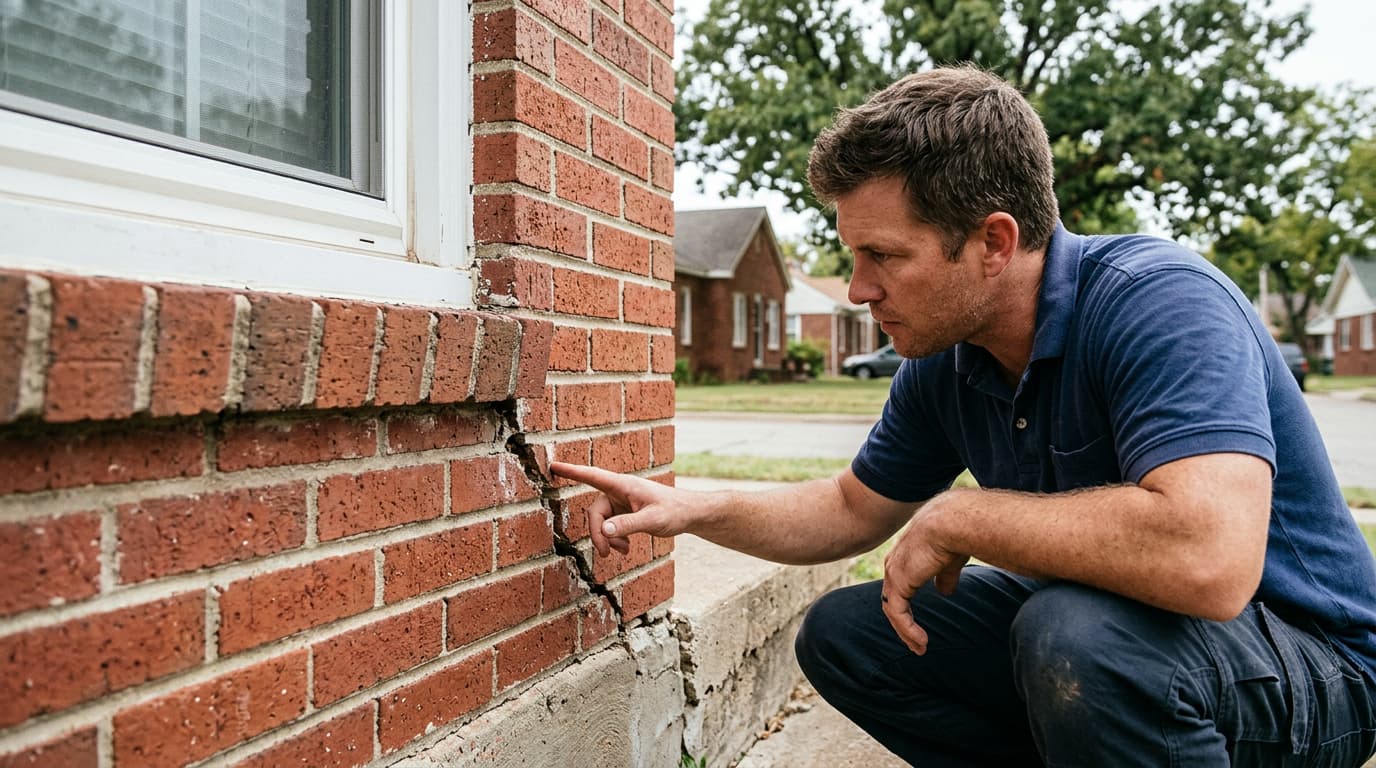
Differential Settlement: The Most Frequent Call in Ada
Differential settlement is the most common foundation call Pierman receives in Ada. It happens when the clay soil beneath a foundation compresses or shifts unevenly, causing one section of the house to drop while adjacent sections stay put. What results is a structure no longer level, with a floor system, wall frame, and door frame absorbing the stress of that misalignment.
In Ada, differential settlement tends to peak during and after summer drought. July and August are the months when the clay pulls back most aggressively. Homes on lots with mature trees are especially vulnerable. A large post oak or pecan within 30 to 40 feet of the foundation draws substantial moisture from the soil, creating a drying zone right next to the structure. Soil in that zone shrinks faster than soil on the other side of the house, and the foundation begins to tilt.
Signs are predictable. A door on the south or west side of the house that started sticking last summer. A hairline diagonal crack running from the corner of a window that was not there two years ago. A floor that slopes toward the back of the house. None of these are cosmetic. They are the structure telling you what is happening below it.
Pier and Beam Deterioration in Ada’s Older Housing Stock
Housing across the city was built substantially between 1940 and 1975. Homes from that era almost universally have pier and beam foundations, and most of them were built without any moisture management in the crawl space below. No vapor barrier. No encapsulation. Just open ground beneath the floor joists, with whatever humidity Oklahoma’s climate wanted to push into that space.
After 50 to 80 years of that, the wood tells the story. Floor joists that absorbed moisture for decades develop soft spots and lose their load-bearing capacity. Beams that carried the weight of the house begin to sag at the center. Piers that sat on surface-level footings shift as the clay beneath them moves. Above the floor, it shows: soft spots in the kitchen, a noticeable dip in the hallway, a bathroom floor that gives slightly underfoot.
Neighborhoods like North Broadway, the areas around East Central University, and the older streets east of the highway have a high concentration of these homes. A pier and beam inspection in these neighborhoods almost always finds at least some moisture-related deterioration, even in homes that look fine from the street. The damage is below the floor, not above it.
Crawl Space Moisture and How It Compounds Each Season
Humidity in this county does not take a season off. April through June brings the rain. July and August bring heat that drives moisture from warm outdoor air into cooler crawl space surfaces, where it condenses on wood. By September, many crawl spaces in Ada have been through six months of continuous moisture exposure without ever drying out fully.
In an unprotected crawl space, the sequence is predictable. High humidity leads to mold on wood surfaces. Mold begins breaking down wood fibers. Soft wood attracts termites and carpenter ants, and their activity accelerates the damage already in progress. By the time a homeowner notices a spongy floor, the crawl space has usually been losing the battle for two or three seasons.
Crawl space encapsulation stops this process before it compounds. For homes in Ada that have never had any moisture management below the floor, an inspection is the first step. Pierman has worked in enough Pontotoc County crawl spaces to know what decades of unmanaged humidity looks like, and to identify how far along the damage has progressed before making any recommendations.
Drainage Patterns That Feed Foundation Movement
Older Ada neighborhoods were not designed with modern drainage standards. Lots that were platted 70 or 80 years ago often slope toward the house, not away from it, or have no graded swale to carry runoff to the street. After a heavy May rain, water concentrates at the foundation base instead of moving away from it.
That concentrated moisture saturates the clay directly beneath the foundation. While the soil 20 feet away dries at a normal rate, the soil under the house stays saturated longer, expands more, and then contracts more when summer arrives. It is the same wet-dry cycle that affects all of Pontotoc County, but concentrated at the worst possible location.
French drains and corrected grading address this directly. A drainage system intercepts runoff before it reaches the foundation and directs it away from the structure. For homes where drainage has been feeding soil movement for years, this is often the most important part of the repair, because fixing the foundation without fixing the drainage means the problem comes back the next wet spring.
What Ada Homeowners Ask About Foundation Problems
How do I know if my Ada home has a foundation problem or just normal settling?
Normal settling is uniform and slow. What you notice with a problem is change: a door that worked fine last year and sticks now, a crack that has grown since you first saw it, a floor that slopes more than it used to. If something has changed in the past one to two years, that change is the signal. Unchanged conditions that have been stable for a decade are low priority.
My home was built in the 1960s. Should I be concerned about the crawl space even if I have not noticed anything?
Yes. Homes built in that era in Ada almost never had vapor barriers installed. Sixty-plus years of Pontotoc County humidity with no moisture management is enough time for wood deterioration to be well underway before any floor symptom appears. An inspection is the only way to know what is actually there.
How much does foundation repair cost in Ada?
It depends entirely on what the inspection finds. A pier shimming job to level a slightly settled section is a completely different scope from beam and joist replacement combined with encapsulation and drainage. Pierman provides a written estimate after the free inspection with no obligation to proceed.
Does Pierman work in the areas around Ada, like Latta or Coalgate?
Yes. Pierman serves communities throughout Pontotoc County and the surrounding area, including Latta, Stonewall, Coalgate, and communities along Highway Ada. The same soil conditions and seasonal patterns that affect Ada affect the entire county, and the foundation problems Pierman sees in these areas match what we see in town.
Pierman Is Based in Ada. This Is Our Home Market.
We have inspected foundations across Pontotoc County long enough to know what the soil does to homes in every neighborhood in Ada. The inspection is free, the estimate is written, and we will tell you exactly what we find before recommending anything.
Prefer to plan ahead? Request your free Pierman inspection online and we will reach out to schedule.
