
Oklahoma does not have one foundation season. It has two, and they work against each other. Heavy spring rains saturate the clay soil and push it to expand. Summer drought pulls the same soil back. Your foundation sits in the middle of that cycle, absorbing the movement in both directions. That back-and-forth is how most settlement in Oklahoma gets started.
Damage like this is rarely a single event. It does not happen overnight. Most of the time it builds across multiple wet and dry seasons until something in the house finally makes it visible: a door, a floor, a crack in the wall. Understanding what drives that cycle tells you why Oklahoma foundations move the way they do and what to watch for before the damage reaches the point of a major repair.
What You Need to Know
- Oklahoma’s expansive clay soil swells when wet and shrinks when dry. That cycle, not a single event, is the primary driver of foundation settlement across the state.
- Prolonged drought is often more damaging than heavy rain. Dry soil shrinks and creates voids beneath the foundation that cause uneven settlement.
- The wet-dry pattern that causes settlement is seasonal and predictable. Homes that have been through many Oklahoma summers accumulate more risk with each cycle.
- Early signs appear inside the house long before the foundation itself looks damaged from outside.
What Makes Oklahoma Soil Different From Most of the Country
Most of the soil beneath Oklahoma homes is clay. Not sandy clay or loamy clay that drains and dries quickly, but expansive clay with a high shrink-swell capacity. It absorbs water and expands in volume. When it dries out it contracts. The USDA classifies most of Oklahoma’s native soils as Hydrologic Group D, the category with the lowest permeability and the highest tendency to hold water and move with moisture changes.
None of this is subtle. According to USDA Natural Resources Conservation Service data on shrink-swell soils, the most active expansive clays can shift two to four inches vertically across a single wet-dry cycle. Oklahoma sits in a zone where that kind of activity is the norm, not the exception.
Your foundation does not float on top of this soil. Movement in the soil means movement in what rests on top of it. When different sections of soil move at different rates, the foundation does not move as a single unit. That uneven movement is what engineers call differential settlement, and it is the kind that causes visible damage.
How Heavy Rain Sets Up the Problem
Spring in Oklahoma brings the heaviest rainfall of the year. Ada averages over four inches of rain in May alone. Across central and southern Oklahoma, April through June consistently delivers more precipitation than the soil can absorb and release quickly. The clay swells. Hydrostatic pressure builds against foundation walls. Water finds paths into crawl spaces and basements.
During a wet period, homes on expansive clay can actually lift slightly as the soil beneath them swells. That lifting is not settlement, but it is part of the same cycle. As the soil dries out and contracts in summer, what lifted will drop. If it drops unevenly, some sections of the foundation lose contact with the soil beneath them entirely.
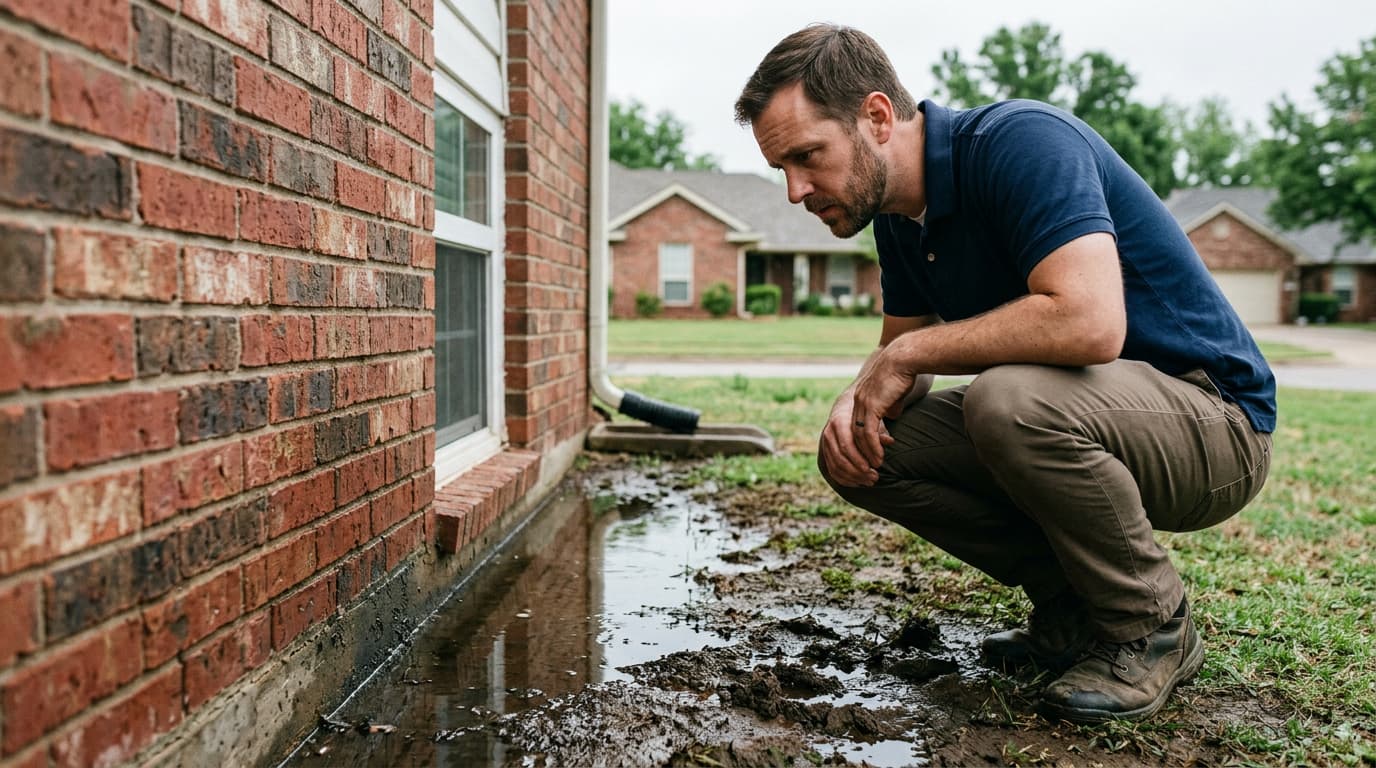
Water pooling near the foundation after rain accelerates the process. Poor grading, clogged gutters, and downspouts too close to the house all concentrate water at the base of the structure. That concentrated moisture creates a zone of highly active soil movement directly beneath the structure, while soil further from the house behaves differently. Uneven movement. Differential settlement.
Why Drought Is Often the More Damaging Half of the Cycle
Rain gets most of the attention. Drought is the part that often does more damage.
Clay soil that dries out does not just stop supporting the foundation. It pulls away from it. Soil shrinks and leaves voids, gaps where there used to be contact between ground and foundation. A house that was resting on firm soil in April may have sections with no soil contact at all by August.
Oklahoma’s summers are reliably dry and hot. July and August temperatures regularly exceed 100 degrees Fahrenheit across much of the state, and the clay soil in an exposed lot can lose moisture rapidly. A mature tree makes this worse. A mature tree with a large root system can pull substantial moisture from the soil within 30 to 40 feet of its trunk, creating a zone of accelerated drying immediately adjacent to the foundation.
Fall rains that return after a long dry summer push the previously contracted soil to reabsorb water quickly and expand again. If the foundation has settled unevenly into the voids created by summer drought, that re-expansion does not always push it back to its original position. Each cycle can leave the foundation slightly further from where it started.
Signs That Settlement Is Already Happening in Your Home
Foundation settlement shows up inside the house before it is obvious from outside. What sits above the foundation telegraphs what is happening below it.
Sticking doors and windows are among the first things homeowners notice. When a section of foundation drops, the frame above it goes out of square. A door that swung freely starts catching at the top or dragging at the bottom. Multiple sticking doors in the same area of the house at the same time is a strong signal.
Diagonal cracks from the corners of windows and doors follow the same logic. That wall is racking, shifting out of plumb as the foundation beneath it drops unevenly. A hairline crack that appeared last year and has not grown is low priority. One that has widened since you first noticed it warrants a closer look.
Floors that slope noticeably in one direction in a slab home mean a section of concrete has dropped. In a pier and beam home, it may point to a pier that has settled or a beam compromised by moisture. Either way, a floor that was level two years ago and slopes now is not aging normally. Something beneath it changed.
Repairing Settlement Caused by Oklahoma Soil Movement
In Pierman’s experience across Pontotoc County and the surrounding area, the homes that arrive at major repair costs are almost always ones where the early signs went unaddressed through two or more wet-dry cycles. What started as a sticking door became sloping floors, then visible wall cracks. Repairing settlement means driving support past the active soil layer to stable ground below. Foundation repair using helical or steel push piers typically reaches 15 to 25 feet in central Oklahoma soils, well below the active zone where moisture changes cause movement. Once the foundation is connected to that stable layer, surface soil activity no longer dictates how the structure sits.
The repair also includes addressing what allowed the settlement to start. Poor drainage near the foundation is corrected with grading and drainage systems that move water away from the structure, not letting it concentrate at the base. Any tree too close may need root barriers or removal as part of a long-term plan.
For homes where settlement is caught early, the repair is more limited in scope. A foundation that has begun to show early signs, sticking doors, minor floor slope, a new crack that appeared last season, is in a better position than one where the settlement has progressed through multiple cycles without attention. The soil is not going to stop moving. Repair needs to happen before the structure above absorbs more of it.
Questions Oklahoma Homeowners Ask About Foundation Settlement
How much settlement is normal for an Oklahoma home?
Some settlement over the lifetime of a home is expected. What matters is whether it is uniform or differential. A house that has settled evenly by half an inch across the whole structure is a different situation entirely from one where one corner has dropped more than the others. Differential settlement is what causes sticking doors, sloping floors, and diagonal cracks.
Will foundation settlement get worse on its own?
In most cases, yes. Oklahoma’s wet-dry cycle continues every year. A foundation that has begun to settle unevenly will generally continue to do so as long as the soil beneath it keeps moving. The rate can slow or speed up with rainfall patterns, but the cause does not resolve without intervention.
Does tree removal help with foundation settlement?
Removing a large tree close to the foundation eliminates an active moisture draw from the soil. In the short term, this can cause the previously dried-out soil to reabsorb moisture and expand, which may actually cause some heave before things stabilize. A foundation specialist can advise on timing and whether root barriers are a better first step than removal.
Is foundation settlement covered by homeowner’s insurance?
Settlement caused by soil movement is excluded from most standard homeowner’s policies. Insurers treat it as a maintenance issue, not a sudden and accidental event. Coverage for foundation damage is usually limited to specific causes like a burst pipe or sudden collapse. Review your policy directly with your insurer.
Seen Any of These Signs After This Year’s Wet or Dry Season?
Pierman has worked with homeowners across Ada, Ardmore, Durant, and central Oklahoma long enough to know what seasonal settlement looks like at every stage. The inspection is free and the estimate is written. We tell you what is happening and what your options are before any work begins.
Prefer to plan ahead? Request your free Pierman inspection online and we will reach out to schedule.
