
If your foundation needs piers, someone is going to ask you to choose between steel and concrete. Both do the same basic job: transfer the weight of your house from unstable surface soil down to something that does not move. How they get there, how deep they go, and how they hold up over the years in Oklahoma’s clay is where the two options separate.
This is not a decision where one answer fits every house. A 1950s pier and beam home in Ada and a 2005 slab home outside Norman have different structures, different loads, and different soil conditions beneath them. Here is how each pier type works, where each one performs best, and the questions worth asking before anyone starts digging under your foundation.
What You Need to Know
- Steel piers are driven deep, usually 20 to 30 feet in Oklahoma soils, reaching load-bearing strata well below the active clay zone.
- Concrete piers are usually installed shallower and rely on the strength of the concrete and the soil around it more than on depth alone.
- Oklahoma’s expansive clay moves seasonally to depths of 10 to 15 feet. Piers that do not reach below that zone move with the soil instead of resisting it.
- Steel typically costs more upfront. The comparison that matters is cost against how long each option keeps the foundation stable in this specific soil.
How Steel Piers Work
Steel piers are hollow steel tubes driven into the ground in sections, one on top of another, using hydraulic pressure. The weight of your house itself provides the resistance that pushes each section down. Installation continues until the pier hits a load-bearing stratum, the point where the soil or rock below is dense enough to stop the pier from advancing.
That stopping point matters more than any other detail in this comparison. In most of central and southern Oklahoma, the active clay zone, the layer that swells and shrinks with moisture, extends 10 to 15 feet below the surface. Steel piers driven to 20 or 30 feet pass entirely through that zone and rest on ground that does not respond to wet springs or dry summers. Once the pier is seated and the foundation is connected to it with a bracket, seasonal soil movement stops dictating what the foundation does.
Lift is the other advantage. Because installation uses hydraulic equipment, the same equipment can raise a settled section of foundation back toward its original position before locking it in place. For homes where settlement has already created visible damage, that recovery is often the difference between stabilizing the problem and actually correcting it.
What Concrete Piers Do Differently
Concrete piers come in two main forms. Pressed concrete pilings are precast concrete cylinders pressed into the ground in segments, similar in method to steel but with concrete as the material. Drilled concrete piers are holes drilled into the soil and filled with poured concrete, sometimes with rebar reinforcement, creating a solid column beneath the foundation.
Depth is where the two systems separate. Concrete piers are installed shallower than steel in most cases. Pressed pilings in Oklahoma reach 8 to 12 feet in most installations. Drilled piers vary by design, but most residential installations stay within the upper soil layers. That depth range sits inside or just below the active clay zone in much of the state, which means the soil around the pier is still moving seasonally.
To be clear, concrete is not a bad material. It has genuine strengths. The material handles compression well, does not corrode, and costs less to produce and install than steel. For lighter structures, stable soil conditions, or projects where budget is the controlling factor, concrete piers are a legitimate option. The question in Oklahoma is not whether concrete is strong enough. It is whether the depth reaches ground that holds still.
The Oklahoma Question: Depth Against Active Clay
Everything about this comparison changes depending on the soil it happens in. In a state with stable, sandy soil, a well-installed concrete pier at 10 feet performs fine for decades. Oklahoma is not that state. The clay here swells with every wet spring and contracts with every dry summer, and that movement reaches deep.
A pier that ends inside the active zone is standing on ground that moves. The pier itself may be solid, but the soil gripping it lifts and drops with the seasons. Over years, that can translate into the same differential movement the pier was installed to prevent. The foundation follows the pier, and the pier follows the soil.
A pier seated below the active zone is standing on ground that does not participate in the seasonal cycle. Wet spring, dry summer, the load path stays the same. That is the core argument for steel in Oklahoma: not that steel is a better material, but that the installation method reliably reaches depths concrete rarely does.
Cost, Lifespan, and What Each Option Really Buys You
On price, concrete wins upfront. Each pier costs less to install. For a typical repair involving 10 to 15 piers, the difference between concrete and steel can be meaningful money, and it is fair to weigh that. Nobody should pretend the price gap does not exist.
The comparison worth making is cost against outcome across the years you own the house. A steel pier system driven to load-bearing strata is generally treated as a permanent repair, and reputable installers back it with transferable lifetime warranties. A concrete system that ends in active clay may perform well for years and then begin moving as the soil around it cycles. If a second repair becomes necessary, the original savings are gone, and the total cost has passed what steel would have been.
None of it is automatic. Plenty of concrete pier installations in the right conditions hold for decades. The variable is the soil, and in Oklahoma that variable works against shallow installations more often than in most states. An honest assessment of your specific lot, soil, and structure is worth more than any general rule.
Questions to Ask Before Choosing a Pier System
Whoever quotes your foundation repair should be able to answer these directly. The answers tell you as much about the contractor as about the pier system.
- How deep will the piers go, and how do you confirm they have reached load-bearing soil?
- Is the warranty transferable if I sell the house, and what exactly does it cover?
- Will the system allow lifting the settled section back toward level, or only stabilizing it where it sits?
- What happens if the foundation moves again after installation? Who pays for the return visit?
A contractor confident in their system answers these without hesitation. Vague answers about depth, non-transferable warranties, and stabilize-only language are worth noting before you sign anything. Foundation repair done correctly is a one-time event. The questions above are how you raise the odds of that.
Common Questions About Pier Systems in Oklahoma
Why does Pierman use concentric steel piers?
Concentric piers drive the load straight down the center of the pier instead of off to one side, which reduces the lateral stress that can cause piers to shift over decades. Combined with depths that pass below Oklahoma’s active clay zone, it is the configuration Pierman has found holds most reliably in the soils we work in across central and southern Oklahoma.
Do steel piers rust in Oklahoma soil?
Galvanized coating protects steel piers from corrosion, and corrosion rates in undisturbed soil are slow. Engineering estimates for galvanized steel piers in typical soil conditions run well past 75 years of service life. The clay content of Oklahoma soil is not especially corrosive compared to coastal or high-salinity environments.
How many piers does a typical repair need?
It depends on the length of the affected foundation section and the loads involved. Piers go in 6 to 8 feet apart along the settled portion. A single corner may need 3 to 4 piers. A full side of a house may need 10 or more. The inspection determines the count, and the written estimate should show exactly where each pier goes and why.
Can piers be installed without tearing up my yard?
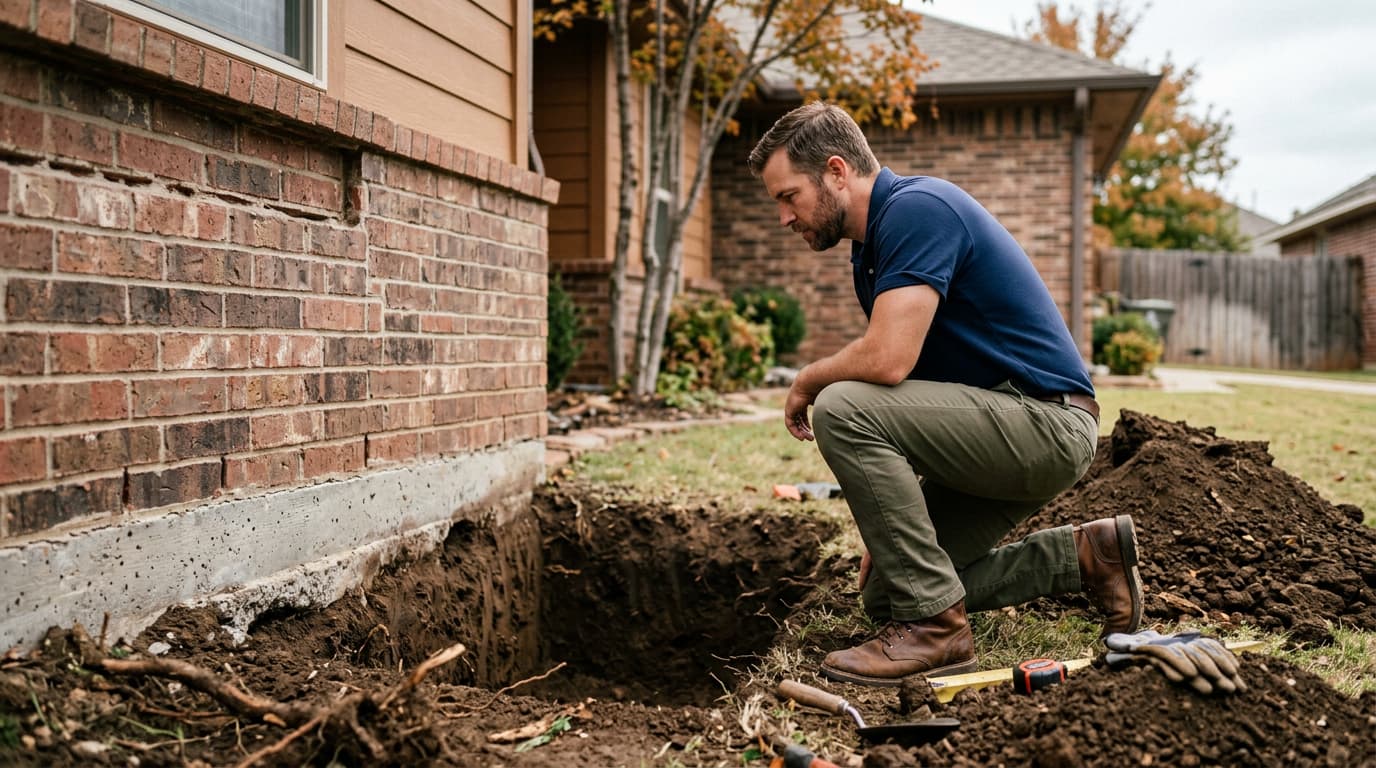
Installation is less invasive than most homeowners expect. Each pier requires a small excavation at the foundation edge, roughly 3 feet square. There is no trenching across the yard and no heavy machinery driving over the lawn. Most installations are completed in one to three days, and the excavations are backfilled when the work is done.
Get a Straight Answer on What Your Foundation Actually Needs
Pierman installs concentric steel piers driven below the active clay zone, and we will tell you plainly whether your situation calls for them or for something simpler. The inspection is free, the estimate is written, and every recommendation comes with the reasoning behind it.
Prefer to plan ahead? Request your free Pierman inspection online and we will reach out to schedule.
