
Tulsa and Broken Arrow sit on the same expansive clay as the rest of Oklahoma, but the housing tells a different story than in most of the state. Broken Arrow grew fast from the 1990s on, and most of that growth went up on slab-on-grade foundations. Midtown Tulsa runs the other direction: homes from the 1920s through the 1950s, many on pier and beam, some with basements you will rarely find further south. Two cities, side by side, with foundation problems that look different on the surface and come from the same ground underneath.
This article covers what that clay does to slab foundations, and why drainage decides how fast the damage arrives. It also sorts the warning signs in your house into three honest categories: the ones that are fine, the ones worth watching, and the ones that mean it is time to call.
What You Need to Know
- Broken Arrow’s newer neighborhoods are dominated by slab foundations, which crack and settle when the clay beneath them shifts unevenly.
- Older Tulsa homes on pier and beam show damage differently: sloping floors and sticking doors before visible cracks.
- Drainage is the multiplier. Water pooling against a foundation after Tulsa’s spring storms accelerates every other problem.
- Not every crack is urgent. Sorting signs by change, not appearance, is what keeps repair costs small.
Why Slab Foundations Dominate Broken Arrow, and What That Means
Broken Arrow added tens of thousands of homes in the past three decades, and nearly all of that construction went slab-on-grade: a single poured concrete pad sitting directly on prepared soil. Slabs are efficient to build and perform well when the ground beneath them stays uniform. Tulsa County clay does not stay uniform. It swells through wet springs and shrinks hard through 100-degree summers, and it does not do either evenly across the footprint of a house.
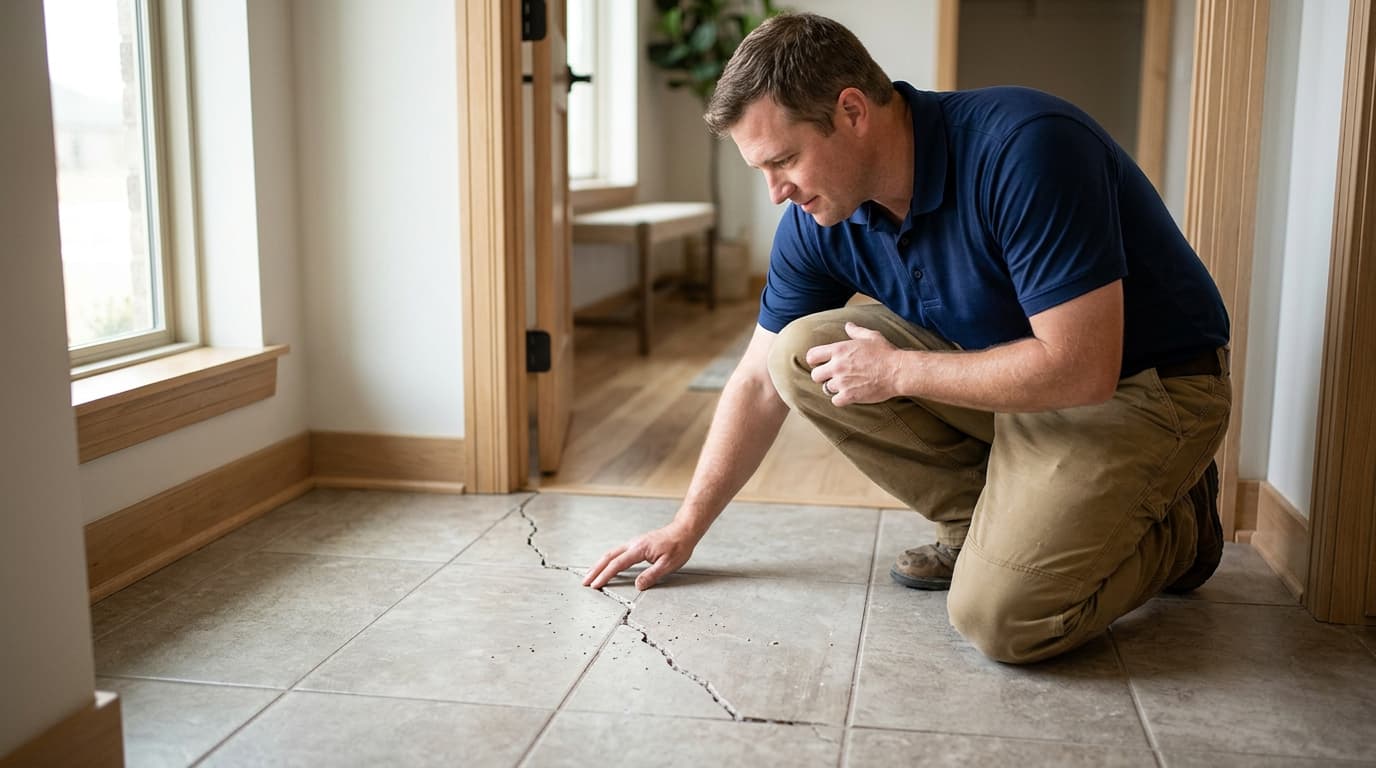
When one section of soil drops and another holds, the slab bridges the gap. Concrete handles compression well and tension poorly, so a bridged slab eventually cracks. Sometimes the crack telegraphs straight up through tile or laminate flooring. Other times the first sign is a hairline line in drywall above a doorway, because the slab flexed and the frame followed.
A cracked slab is not automatically an emergency. Hairline shrinkage cracks from the original cure are common and harmless. What matters is differential movement: one side of the crack sitting higher than the other, a crack that widens season over season, or new flooring damage appearing along a line. Those point to the soil, not the concrete.
Older Tulsa Homes Play by Different Rules
Midtown and the neighborhoods ringing downtown Tulsa were built long before slab construction took over. Pier and beam is everywhere, and basements show up more often here than almost anywhere else in Oklahoma. These homes handle soil movement differently. A pier and beam house flexes: piers settle individually, beams sag where moisture has weakened them, and the first symptoms are floors that slope and doors that drift out of alignment, not cracks in a slab.
Basements add their own problem. A basement wall is a retaining wall, holding back soil that swells every wet season. Decades of that lateral push is how bowing walls happen, and Tulsa’s older basement homes see it after strings of wet years. A wall curving inward is not a watch-it item in any category. It gets attention now.
Years on the clock matter too: these homes have run more cycles. A 1935 Brookside bungalow has been through 90 wet-dry seasons. Whatever weaknesses the structure has, the clay has had 90 chances to find them.
Drainage Is the Multiplier in Both Cities
Rain in the Tulsa metro averages around 41 inches a year, and spring storms here arrive hard and fast. A yard that sheds that water away from the house keeps the clay near the foundation on the same schedule as the rest of the lot. A yard that pools it against the slab edge or the basement wall puts the soil under the house on its own accelerated cycle: wetter than everything around it in spring, and collapsing further in summer.
That is why two identical houses on the same Broken Arrow street can age so differently. The one with clean gutters, downspout extensions, and grade falling away from the foundation runs the normal Oklahoma cycle. Its neighbor with a flowerbed dammed against the slab and a downspout dumping at the corner runs the hard version, and its foundation shows it years earlier.
Correcting drainage is the highest-leverage prevention available in either city. French drains, regrading, and downspout management cost a fraction of foundation work and slow the cycle that causes it.
Sorting the Warning Signs: Fine, Watch, or Call
Every house shows something if you look hard enough. What separates a maintenance note from a repair call is change. Here is how Pierman sorts what Tulsa and Broken Arrow homeowners report, into three honest buckets.
Usually fine. Hairline cracks in drywall corners that have not moved in years. Thin shrinkage cracks in a garage slab from the original cure. A single door that sticks in humid weeks and frees up in fall. These are cosmetic or seasonal, worth a photo for your records and nothing more.
Worth watching. A crack you are not sure has grown: mark the ends with pencil and date it. A door that started sticking this year and has not let go. A gap opening between baseboard and floor. Check these monthly. Growth or company, meaning new symptoms joining them, moves them up a bucket.
Call now. Diagonal cracks widening from window or door corners. A floor with a slope you can feel walking across it. Multiple doors in one area failing together. Any basement wall curving inward. Flooring damage appearing along a line across the room. These mean the movement is active, and active movement does not stop on its own.
The pencil-mark trick costs nothing and answers the question that matters most. A crack that has not moved in a year is history. A crack that crossed your pencil line is a phone call.
What Repair Looks Like for Slab and Pier and Beam
For settled slabs, foundation repair means transferring the load to ground that does not move. Steel piers driven 20 to 30 feet reach below the active clay layer, which in the Tulsa area runs roughly 10 to 15 feet deep. Brackets connect the slab edge to the piers, and the settled section can be lifted back toward level before locking in place. The seasonal cycle keeps running in the soil. Your house stops participating in it.
Pier and beam repair in older Tulsa homes is often more surgical: shimming or replacing individual piers, reinforcing or swapping beams that moisture has taken, and addressing the crawl space conditions that caused the deterioration. Bowing basement walls need lateral reinforcement, and the drainage that loaded the wall gets corrected in the same project or the fix fights the same water again.
All of these repairs start the same way: someone qualified looks at the actual house and tells you which bucket each symptom belongs in. In Pierman’s experience across the Tulsa metro, the homeowners who call while their signs are still in the watch bucket spend a fraction of what the call-now group spends. The soil does not negotiate, but the timing is yours.
Common Questions From Tulsa and Broken Arrow Homeowners
Is a crack in my slab always a foundation problem?
No. Concrete shrinks slightly as it cures, and thin surface cracks from that process are normal in slabs of any age. The cracks that matter show differential movement: one side higher than the other, widening across seasons, or damage appearing in the flooring above along the same line.
My Broken Arrow home is less than 15 years old. Why is it settling already?
Age is only one variable. Fill soil that was not compacted evenly during construction, drainage that concentrates water at one corner, or a large tree maturing near the slab can all produce settlement in a young home. The clay does not check the build date.
Do the older Tulsa neighborhoods have worse foundation problems than Broken Arrow?
Different, more than worse. Older pier and beam homes have run more cycles and show moisture-related wood problems slabs never have. Newer slab homes concentrate their risk in soil prep and drainage. Both respond well to repair when the signs are caught early.
Does foundation work in one part of the house protect the rest of it?
Piers stabilize the sections they support. If the soil is moving under one corner today, the conditions driving that movement, usually water, can reach other sections later. That is why a good repair plan pairs the piers with the drainage correction, so the cause gets fixed along with the symptom.
Not Sure Which Bucket Your House Is In?
That is exactly what the inspection answers. Pierman looks at what your Tulsa or Broken Arrow home is actually showing, tells you which signs matter and which do not, and puts it in writing. Free, and with no obligation to go further.
Prefer to plan ahead? Request your free Pierman inspection online and we will reach out to schedule.
