
There is no correct number.
That is the honest answer to how deep foundation piers should go, and it is the answer most homeowners do not want to hear. They want a figure they can compare across quotes. What they get instead, from anyone doing the work properly, is a principle: the pier goes as deep as it takes to reach ground that does not move. Across most of Oklahoma that lands somewhere between 20 and 30 feet. Some spots reach it at 12. Others are past 40.
Here is where those numbers come from, what decides them on a specific lot, how they shift across the state, and how to tell whether the depth on your estimate was measured or guessed.
What You Need to Know
- Pier depth is set by the ground, not by a chart. The pier is driven until it reaches soil or rock dense enough to carry the house, and that depth is different on every lot.
- In Oklahoma, the soil that swells and shrinks with the seasons extends roughly 10 to 15 feet down. A pier that stops inside that layer is standing on ground that still moves.
- Any quote that lists a fixed depth for every pier before the crew has driven one is describing a plan, not a measurement. Ask how the number will be confirmed.
The Short Answer and Why It Is Not a Number
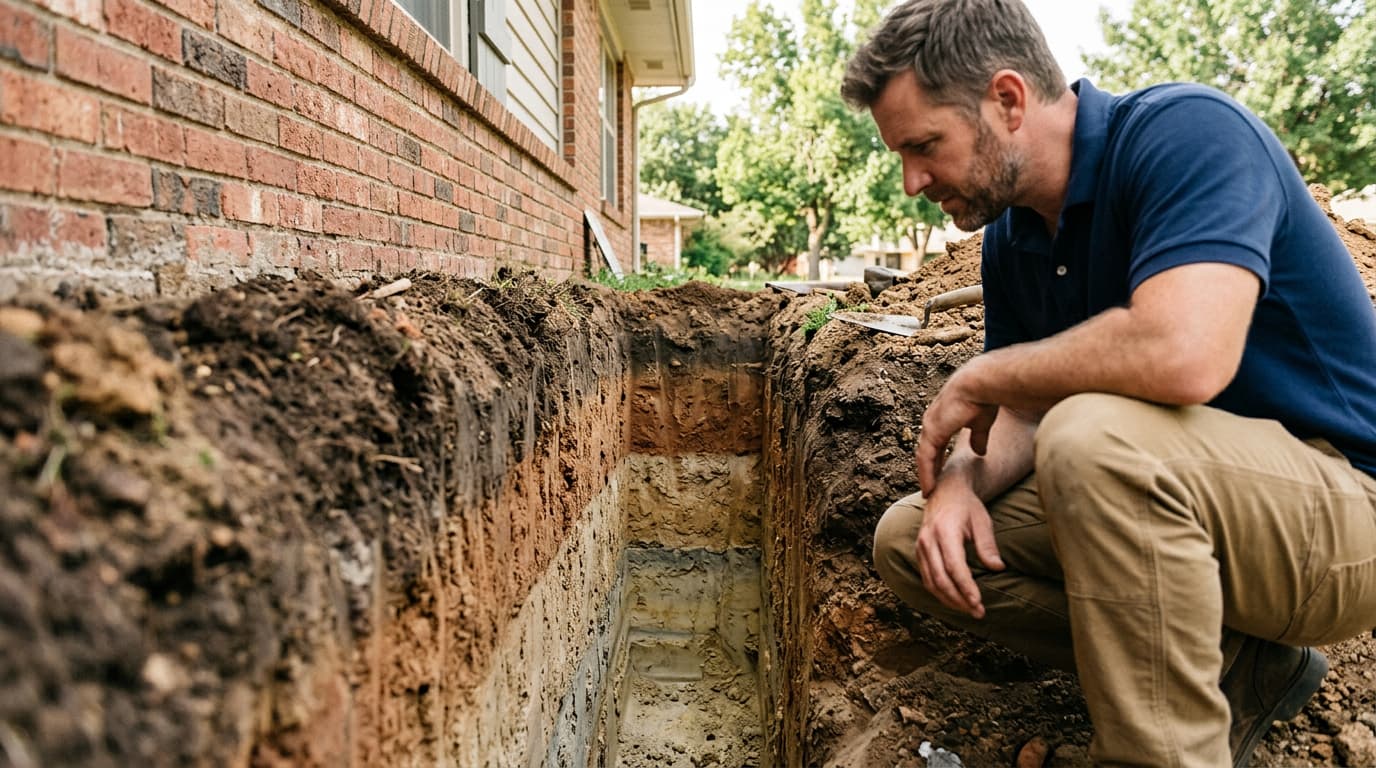
A foundation pier has one job: carry the weight of the house past soil that moves and set it down on ground that does not. How far down that ground sits is a property of the lot, not the pier. Engineers call the moving layer the active zone. It is the band of soil close enough to the surface that rain and drought change its moisture, and in Oklahoma’s clay, moisture change means volume change. Clay swells wet and shrinks dry, and anything resting inside that band rides along.
Below the active zone the soil stays at a steady moisture level year-round. It does not care whether May was wet or August was brutal. That is where a pier needs to end, and a good installation keeps going until it gets there. The number on the estimate is a forecast. What matters is the one the crew reads off the equipment when the pier stops advancing.
So when someone asks how deep piers go in Oklahoma, the useful reply is: through the active zone, and into whatever holds. Commonly that means 20 to 30 feet for driven steel piers in the central part of the state. That word commonly is doing a lot of work in the sentence.
Four Things That Set the Depth on a Specific Lot
Two houses on the same street can need piers of different lengths. These are the variables that push the number up or down.
How deep the clay runs before it hits something firmer. Parts of Oklahoma sit on thick clay deposits that go down 30 feet or more before reaching dense material. Other areas have shale, sandstone, or limestone within 15 feet of the surface. A pier stops where the firm layer starts. Deep clay means deep piers.
Trees and drainage. A mature tree pulls moisture from a wide radius of soil and can push the active zone deeper on its side of the house. Poor drainage does the opposite kind of damage but the same thing to depth: it keeps a section of soil wetter and more active than the rest of the lot. Both mean the stable layer sits further down near that part of the foundation.
How much the house weighs. A two-story brick home puts more load on each pier than a single-story frame house. Heavier load needs denser bearing soil, which sometimes means passing through a layer that would have been adequate for a lighter structure and continuing down.
Which pier system is used. Driven steel piers advance until resistance from the soil exceeds the pressure pushing them, so depth is discovered during installation. Drilled or pressed concrete systems are often built to a planned depth instead, which is why they tend to end shallower. The method decides whether the ground gets a vote.
Depth Changes Across Oklahoma, and Here Is Roughly How
Oklahoma is not one soil. The state sits across several geologic regions, and pier depth tracks them. These are general patterns, not promises, because the only depth that counts is the one measured under your house.
Central Oklahoma, from the Oklahoma City metro down through Norman and Moore, sits on red clay and shale that can run deep before firming up. Piers here tend to land in the 20 to 30 foot range, sometimes further where the clay is thick and the lot has drainage trouble.
South-central Oklahoma around Ada and Pontotoc County is near the Arbuckle uplift, where limestone and shale sometimes sit closer to the surface. Some lots reach bearing rock inside 15 feet. Others, a few miles away on thicker clay, need every bit of 25.
Southeastern Oklahoma toward Durant and the Red River valley carries deeper river-deposited soils and the highest rainfall in the state. Active zones can run deeper here, and piers follow. Northeastern Oklahoma around Tulsa mixes clay with shallower rock in places, so depth varies block to block more than in the central plains.
What Depth Should Look Like on Your Estimate and Your Invoice
Before the work, the estimate can only give a projection: expected depth based on soil in the area, the house, and the inspection. That projection is fine. What is not fine is a projection presented as a fact, or a single number applied to every pier with no explanation of how it will be verified.
After the work, the documentation should change. Each pier location should have a recorded depth, the actual figure reached when the pier seated. Driven steel systems produce this naturally, because the crew reads pressure and section count as they go. If the final paperwork shows the same round number for every pier on the house, that is worth a question, because ground almost never cooperates that evenly.
This is also where the warranty connects to the depth. A warranty against further settlement means something when the piers are documented to have reached bearing strata. It means less when nobody can say where they stopped. Foundation repair done properly leaves a paper trail that a future buyer, an inspector, or you five years from now can read.
Deeper Is Not the Same as Better
Once the pier reaches ground that holds, going further adds cost without adding stability. A pier seated at 24 feet on dense shale is not improved by driving it to 40. Bearing is the goal, not depth for its own sake, and a contractor pushing a bigger number as a selling point has the logic backwards.
Stopping short is the real risk. A pier that stops at 12 feet because that was the plan, on a lot where the clay keeps moving down to 15, is a pier standing in the active zone. It will hold the house for a while. Then a wet spring and a dry summer will move the soil around it, and the house will follow. In Pierman’s work across central and south-central Oklahoma, the settled foundations that had already been piered once almost always trace back to that: the first repair stopped short of where the ground actually changes.
Depth Questions Oklahoma Homeowners Ask
Is there a minimum depth piers have to reach by code?
Building codes address footing depth for new construction, usually tied to frost line, which in Oklahoma is shallow. Repair piers are governed by reaching adequate bearing, which the engineer or installer determines from soil conditions, not from a fixed code number. Local permitting varies by city, so ask whether your project needs one.
Can you tell the depth before you start?
Only as an estimate. Soil reports for the area, nearby projects, and the inspection give a reasonable projection. The actual depth is confirmed pier by pier during installation, and it is normal for it to vary several feet across a single house.
Why did my neighbor’s piers go 18 feet and mine need 28?
Because the ground under the two houses is different, even if the yards look the same. A thicker pocket of clay, a big tree on your side, or a drainage pattern that keeps one corner wet can each move the bearing point. So can a slope in the rock layer underneath. Ten feet of difference between neighbors is not unusual. Depth is measured, not inherited.
Does a deeper pier cost more?
Additional sections add material and time, so yes, within reason. Ask how the estimate handles depth that runs longer than projected. Some contractors price per pier to a projected depth with a stated rate for extra sections. Others build in a range. Either is fine as long as it is written down before the crew arrives.
Do piers ever stop too shallow by accident?
They can, if the crew mistakes a hard pocket for bearing strata. Experienced installers recognize the difference.
Want to Know What the Ground Under Your House Will Say?
Pierman drives piers until they reach bearing and records the depth on every one. The inspection is free, the estimate is written with projected depths and how they will be confirmed, and there is no obligation to go further.
Prefer to plan ahead? Request your free Pierman inspection online and we will reach out to schedule.
