
Muskogee was built early. Railroads and oil money put up much of the town’s older core in the first decades of the 1900s. Many of those houses still stand on the pier and beam foundations they were built with. They have held up through a century of east Oklahoma weather, which says something about how they were made. It also means the wood under them has been doing its job for a long time, in the wetter, eastern half of the state.
What You Need to Know
- Muskogee sits in the wet eastern half of Oklahoma, averaging around 44 inches of rain a year, and that moisture has to go somewhere.
- A pier and beam foundation is four separate things: piers, beams, floor joists, and the crawl space around them. Each one fails differently.
- Many homes in the older parts of town were built before vapor barriers (plastic sheeting laid over the crawl space dirt) were common. Unless someone added one later, the ground under them is bare.
- Wood does not fail suddenly. It softens over years, and the floor above is usually the first place anyone notices.
- Repairs are component specific. A settled pier and a rotted beam need different work, and an inspection is what tells them apart.
Why Foundation Repair in Muskogee, OK Starts With Moisture
Three rivers meet near this town. The Verdigris and the Grand both empty into the Arkansas a few miles northeast of Muskogee, an area long known as Three Forks. That history left soil the rivers laid down near the water, expansive clay further out, and low ground near the rivers that stays wet for long stretches.
Rainfall adds to it. Eastern Oklahoma is the wet end of the state, while the western panhandle gets under 20 inches a year. The clay absorbs what it can and holds it. Summer heat pulls it back out. The swing between those two states is what moves the ground, and the ground is what moves the house.
On a slab home, that movement shows up as cracks. For a pier and beam home, it shows up as a system of separate parts shifting at different rates, with a humid crawl space underneath working on the wood the whole time. Four parts sit under every pier and beam house, and in a town that averages about 44 inches of rain a year, every one of them gets wet.
Piers: What Holds the House Up
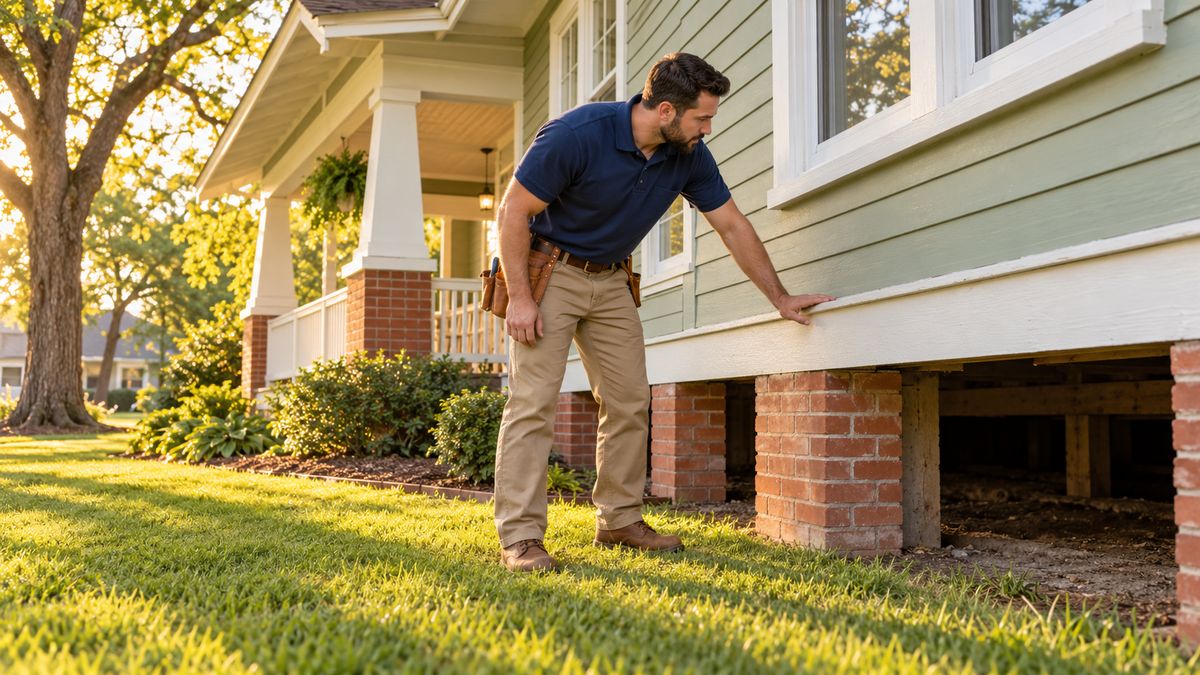
Piers are the columns that carry the load down to the ground. In homes built around Muskogee’s boom years, they are often stacked stone, brick, or poured concrete sitting on a shallow footing. Some rest on nothing more than compacted soil, because that was normal practice at the time.
When the clay beneath a pier shrinks through a dry August, the pier settles into the space that opens up. It does not come back up when the rain returns. Do that for seventy or eighty summers and the piers under one side of a house can sit measurably lower than the piers under the other. Older brick and stone piers can also lose the mortar between bricks and start to lean instead of sink.
A settled pier is often the simplest repair in the whole system. Shimming or replacing individual piers can bring that section back toward level without touching the rest of the system, as long as the beam resting on it is still sound. That last part is the catch. Before anyone quotes pier work on your house, has anyone checked the beam sitting on top of it?
Beams: Where Muskogee Humidity Does Its Damage
Beams are the horizontal timbers that span between piers and carry the floor. They sit low, close to the ground, in the most humid air in the house. In a crawl space with no vapor barrier and open vents, that air is damp most of the year in this part of Oklahoma.
Wood that stays damp loses density. A beam can appear perfectly normal and still give under a screwdriver tip, because the decay works from the inside and from the ends, where it sits on the pier. The ends go first, exactly where the load concentrates.
A sagging beam produces a floor that dips in the middle of a span instead of sloping toward a corner. A slope points at the piers. A dip points at the wood, and wood that has softened does not get shimmed back into service. It gets reinforced or replaced.
This is the part of pier and beam repair that grows the longer it waits. A beam soft only at the ends is a different job from one that has failed along its length. When did anyone last push a screwdriver into the beam ends under your floor?
Joists: What You Feel Underfoot
Floor joists run across the beams and carry the subfloor directly. Smaller than beams, they let moisture reach their middle faster. They are also the component homeowners sense first, because a weakened joist is what turns a solid floor into a springy one.
Bathrooms and kitchens are the usual starting point, and not only because of the plumbing. Those rooms sit over joists that have been dealing with both crawl space humidity from below and the occasional small leak from above for decades. A soft spot in front of a tub or under a sink is a joist telling you it has been wet more often than it has been dry.
Joists usually fail in one small area first. Fastening a new joist alongside a weakened one can restore the span without tearing out the floor. Does one spot in your bathroom or kitchen floor give a little when you step on it?
Crawl Space: The Condition That Drives the Other Three
The piers, beams, and joists all live in the same box. Whatever that box does to wood, it does to all of it, which is why the crawl space works more like a condition than a part.
An open crawl space under a Muskogee home takes ground moisture from below and humid outside air through the vents. In July and August, that outside air is warm and wet, and the surfaces inside the crawl space are cooler. Water condenses on the joists and beams on days when it has not rained at all. Most of the time, crawl space moisture means air, not standing water.
Inside the house, look for a musty smell that is stronger after rain, and floors that feel cool and slightly soft near exterior walls. Under the house, insulation that has fallen out from between the joists soaked up enough water to get heavy.
Sealing the ground and managing the air with crawl space encapsulation stops the process that softened the wood in the first place. It does not reverse what already happened, which is why it tends to be paired with whatever repair work the inspection found. Fix the wood, then fix what wore it down. When did someone last go all the way under your house with a flashlight?
Questions From Muskogee Homeowners
How do I tell whether my floor problem is the piers or the wood?
Set a marble in a few rooms and watch it. If it rolls the same direction everywhere, the piers on the low side have likely settled. When it rolls toward the middle of a room from both sides, the wood between piers is the more likely problem. Doors that stick only in one part of the house help narrow it further. Many older homes have both going on, which is why the inspection checks floor height and the wood, not one or the other.
My house has stood for a hundred years. Why would it need work now?
Because the clock never stopped. Each wet and dry season moves the soil a little and each humid summer works on the wood a little. A house that was fine twenty years ago has simply had twenty more cycles since. Age is not a defect in these homes, but it is a reason to look instead of assume.
Can I inspect my own crawl space?
You can look, and looking is better than not looking. With a flashlight you can see standing water, fallen insulation, dark staining on the wood, and obvious pier movement. What you will not see from the access panel is interior decay in a beam that looks fine, or how far out of level the floor system actually sits. Both of those take tools and getting all the way under the house.
Does pier and beam repair mean I have to move out?
Usually not. Pier and beam work is done from the crawl space, below the floor, not through your living room. Expect some noise and a crew using the access point. If you are worried about a specific room, ask about it during the inspection.
Is it worth repairing an older home, or is this throwing money at an old house?
The structure of these homes is usually the part worth keeping. Old growth framing lumber is denser than what gets milled today, and the design gives access to everything underneath, which a slab does not. What fails is the wood that stayed wet and the piers that lost their footing, and both are repairable components, not the house itself.
Find Out Which Part Is Actually Moving
Piers, beams, joists and crawl space all produce symptoms that feel alike from inside the house. Pierman provides foundation repair in Muskogee, OK and many other Oklahoma cities. The inspection is what separates the four. It is free, and the estimate is written.
Prefer to plan ahead? Request your free Pierman inspection online and we will reach out to schedule.
