
If you own a home in Oklahoma, the ground beneath your foundation moves. Every wet season it expands. Every dry summer it pulls back. That happens year after year, and your foundation sits on top of all of it. Understanding what that does to a house is how you catch problems before they become expensive ones.
This article covers what that movement does to Oklahoma foundations, what warning signs to watch for inside your home, and what the most common repair situations actually look like. Most of what foundation contractors deal with here comes down to a few predictable patterns that are worth understanding before something shows up in your house.
What You Need to Know
- Oklahoma’s clay soil expands when wet and contracts when dry, putting constant pressure on every foundation in the state.
- Older homes on pier and beam foundations and newer homes on slab are both vulnerable, just in different ways.
- Foundation problems rarely show up as obvious cracks first. They show up as sticking doors, sloping floors, and musty smells.
- Catching a problem early almost always means a smaller, less expensive repair. The soil does not stop moving on its own.
Why Oklahoma Is Hard on Foundations
The main culprit is the clay soil that covers most of the state. Clay is what engineers call expansive soil. Wet weather makes it swell. Dry summers make it pull back. In a place like Oklahoma, where more than half the state sits on soils rated at high shrink-swell risk, that cycle is especially aggressive.
Ground that never fully stabilizes is the reality here. Oklahoma’s soils are classified as Hydrologic Group D by the USDA, the highest shrink-swell category, which means they absorb water slowly and hold it long. That instability causes the foundation to shift, settle, or crack. It is not a sign that your house was built poorly. This is the environment every Oklahoma homeowner is working with.
And it is not limited to one part of the state. Whether you are in Oklahoma City, Edmond, Norman, or a smaller town 60 miles south, you are dealing with the same soil, the same expansion, and the same contraction.
Pier and Beam vs. Slab: The Two Foundation Types You Will Find Here
Oklahoma homes generally fall into one of two foundation types.
Older homes, built before the 1980s, tend to have pier and beam foundations. The house sits elevated above the ground on a system of piers and beams, with a crawl space underneath. That crawl space is useful for accessing plumbing and wiring, but it also collects moisture. In Oklahoma’s climate, a crawl space that is not properly sealed becomes a breeding ground for mold, wood rot, and damage that works its way up into the living area.
Newer homes are more commonly built on a concrete slab poured directly on the ground. Slab foundations are lower maintenance in some ways, but they are equally vulnerable to Oklahoma’s soil movement. When the ground shifts, the slab shifts with it.
Both types have their vulnerabilities, and both are repairable. The key is catching problems early, before what starts as a minor crack or a slightly sticking door turns into something that requires a much bigger repair.
Warning Signs to Watch For
Foundation issues show up in places you would not immediately connect to the foundation, and they rarely announce themselves all at once. These are the ones worth knowing.
Doors and windows that stick. A door that used to swing freely and now catches at the top or drags at the bottom is one of the earliest signs. One sticking door could be humidity. Two or three in the same part of the house at the same time is a foundation conversation.
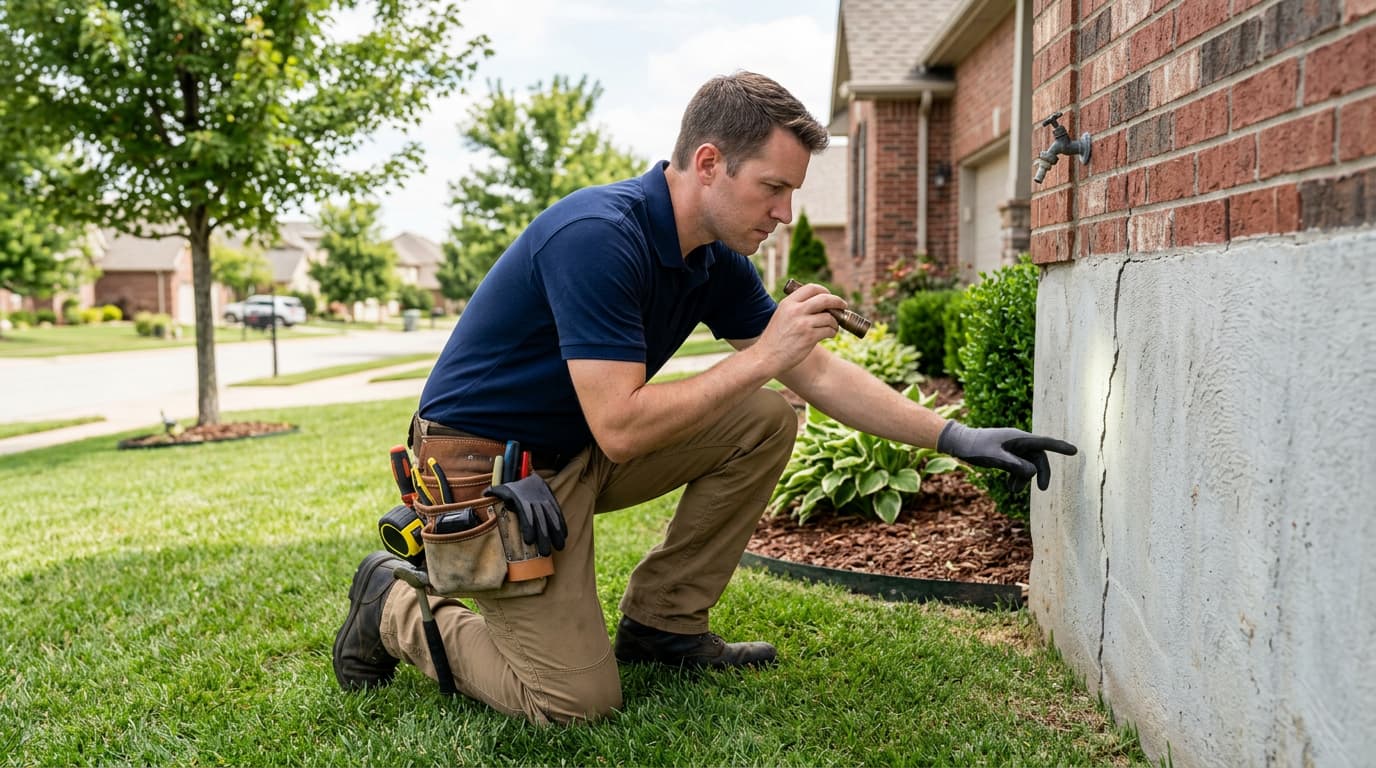
Cracks in your walls. Diagonal cracks from the corners of windows and doors are the ones that matter. Hairline cracks in drywall are common and rarely a problem. What changes the picture: a crack wider than a quarter inch, one that has grown since you first noticed it, or cracks appearing alongside other symptoms on this list.
Uneven or sloping floors. Floors that slope noticeably in one direction are telling you something. In a pier and beam home, it usually points to a pier that has settled or a beam that moisture has weakened. In a slab home, it means a section of concrete has dropped. Either way, it does not fix itself.
A musty smell from your floors or lower walls. In a pier and beam home, that smell points to moisture sitting in the crawl space. It is easy to write off as an old house thing. It is not. By the time you notice it inside, the issue below has been building for months.
Gaps between walls and ceilings, or along the floor, also matter. Separation at those joints means the structure is moving. A gap that appeared recently and is growing needs attention. One that has not changed in years is worth watching but not necessarily urgent.
Bowing or leaning walls. Walls curving inward mean the soil outside is pushing hard enough to move them. Do not monitor this one. Call.
Common Foundation Problems You Will Find in Oklahoma Homes
Foundation settlement happens when the soil beneath the foundation compresses or shifts unevenly, causing part of the house to drop. It is the most common reason Oklahoma homeowners call a foundation repair specialist, and it shows up as sloping floors, sticking doors, or diagonal wall cracks. In Oklahoma, settlement is most likely during prolonged dry spells when the clay soil shrinks and creates voids under the foundation.
Pier and beam deterioration. In older Oklahoma homes, the crawl space is where trouble starts. Moisture sits on the wood long enough for rot to take hold in the beams and floor joists. The piers can sink when the soil beneath them shifts. By the time your floor shows it, the damage below has been going on for a while.
Not every crack is a problem. Thin ones that have not moved in years are low priority. What changes that picture: a crack that is widening, a horizontal crack in block or brick, or anything showing up alongside bowing walls. Those are worth a call.
Crawl space moisture. Standing water, high humidity, no ventilation. Those three things together are how mold and wood rot get started under a house. By the time the floor above feels soft, the crawl space has already been losing the battle for a while. A properly encapsulated crawl space stops that before it starts.
Drainage issues are often where the problem actually starts. Water that pools near your foundation after rain saturates the clay and accelerates movement. French drains and proper grading keep that water moving away from the house instead of into the soil beneath it.
What Happens When You Delay the Repair
Foundation problems do not stabilize on their own. The soil keeps moving. The crack keeps widening. The moisture keeps sitting on the wood. Nobody calls a foundation contractor too early. Plenty of homeowners call too late.
Catching a problem early almost always means a smaller fix. A free inspection takes an hour and gives you a clear picture of what is actually there, including the option of watching something minor rather than jumping on it immediately. That is a good position to be in.
When to Call a Foundation Specialist
If you are seeing any of these, do not wait for a second opinion.
Some signs need attention sooner: walls bowing inward, floors with a noticeable slope that developed in the past year, or cracks wider than a quarter inch that are still growing. These do not wait well.
- Multiple doors or windows sticking at the same time
- A crawl space with visible mold, standing water, or soft and spongy wood
- Gaps between walls and ceilings or floors that have recently appeared or are widening
A good contractor tells you what is there, what it means, and what your options are. You decide what to do next. The inspection does not commit you to anything.
People Also Ask About Oklahoma Foundations
Does homeowner’s insurance cover foundation repair?
Most standard policies cover sudden and accidental damage, like a pipe burst that floods your crawl space, but not settlement caused by soil movement year after year. That is the cause in most Oklahoma claims. Coverage varies. Check your policy directly with your insurer before assuming anything is covered.
How much does a foundation inspection cost?
Reputable foundation repair companies offer free inspections. If a company charges for an initial visit before giving you any information, that is worth noting before you commit to anything further.
Can I live in my home during foundation repairs?
In most cases, yes. Pier installation, crawl space work, and most foundation repairs do not require you to vacate. Your contractor will let you know if any phase of the work requires you to stay out of a specific area temporarily.
How long does foundation repair last?
It depends on the type of repair. Crack fillings and minor patching can last 5 to 10 years. Major stabilization work using piers is considered a long-term fix when done correctly. The goal is to address the root cause, not the visible symptom alone.
How do I know if a crack is serious or just cosmetic?
Width, direction, and whether it has grown are the three things to look at. Hairline cracks that have not moved in years are usually cosmetic. Cracks wider than a quarter inch, diagonal cracks running from corners of openings, and any crack that has visibly grown since you first noticed it are worth a professional opinion.
What is the best time of year to do foundation work in Oklahoma?
Spring and fall tend to be practical times, when the soil is not at its most extreme. That said, foundation repairs can be done year-round. Urgent work should not wait for a particular season.
Noticed Something Around Your Home?
Pierman has worked with homeowners in Ada, Oklahoma City, Edmond, Norman, Moore, and across the state. We know what Oklahoma soil does to foundations at every stage. The inspection is free, the estimate is written, and we will tell you exactly what is happening before recommending anything.
Prefer to plan ahead? Request your free Pierman inspection online and we will reach out to schedule.
