
Most foundation trouble in Ardmore starts quiet.
A hairline crack over a bedroom door. A back door that needs a hip check to latch in August and swings fine again by March. A gap where the baseboard used to meet the floor. None of it looks like an emergency, so it gets painted over, planed down or ignored, and the house keeps moving underneath.
If you are weighing foundation repair in Ardmore, OK, this guide sorts the warning signs into three stages: what to watch, what to measure, and what needs a call this week. It also explains why Carter County ground produces those signs in the first place, so you can tell the difference between a house that is settling in and a foundation that needs repair.
What You Need to Know
- Carter County has clay soils, like the Tamford series, that shrink and crack open when they dry, then swell when they get wet.
- A sign that comes and goes with the seasons is still a sign. It means the soil is moving the house.
- Cracks wider than a nickel’s thickness, stair-step cracks in brick, and floors you can feel sloping are past the watch stage.
- Water is the part you control: gutters, downspouts, the slope of the yard and leaks under the house.
- Not sure which stage your house is in? Photograph every crack with a date on it. That record answers the question faster than guessing.
Carter County Clay and Foundation Repair in Ardmore, OK
A lot of Ardmore homes sit on clay that moves. The USDA keeps an official description for a clay soil called Tamford, and its official type location, the reference site for that soil, is in Carter County. When it dries out, it opens cracks up to about two inches wide, measured 20 inches below the surface.
Put a house on that ground and every season pushes or pulls on it. In a long, hot summer the clay under the edges of the slab dries and shrinks first, so the corners and the outside walls drop a little while the middle of the house stays put. In a wet spring the clay takes on water and swells, and the same corners lift. A house built on a slab or on piers and beams rides that cycle year after year.
That is why so many Ardmore warning signs change with the weather. You are not imagining it. The soil is moving, and the cracks, sticking doors and sloping floors are where the movement shows up first.
Early Signs: Small Changes Worth Watching
Early signs are easy to explain away, but they show up while the fix is still small.
Hairline drywall cracks. Thin cracks that run out from the corners of doors and windows, or along a ceiling joint, are often the first thing homeowners notice. One crack on its own can be drywall tape or normal shrinkage. Several that show up in the same part of the house, or a crack that comes back after it was patched, point to the frame shifting.
Doors that change with the seasons. A door that rubs at the top corner in summer and closes fine in winter is following the clay. Look at the gap around the door when it is shut. If it is wider at the top on one side than the other, the frame is no longer square.
Small gaps at trim. Look where baseboards meet the floor and where crown molding meets the ceiling. A thin gap that was not there last year is worth a photo. At this stage, the best thing you can do is start a record: date, location, and a coin or ruler in the picture for scale. Six months of photos will tell you more than any single look.
Middle Signs: Things You Can Measure
Once the signs get bigger, you can check them with a coin, a pencil and a phone camera. Mark both ends of a crack with a pencil and the date, and you will know within a few weeks whether it is growing.
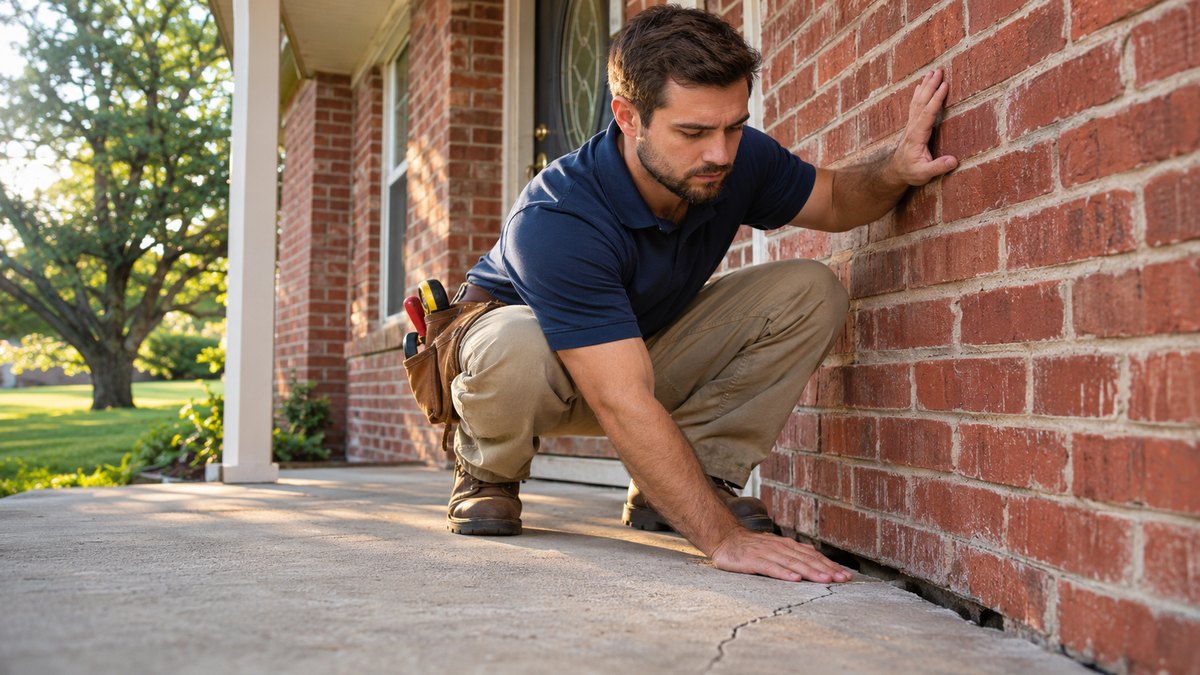
Stair-step cracks in brick. On a brick home, cracks that climb the mortar joints in a stair pattern, usually starting at the corner of a window or near the end of a wall, mean one part of the foundation has dropped relative to another. If you can slide a nickel into the crack, it is past cosmetic.
Floors you can feel. Set a marble or a round pencil on a hard floor and watch where it rolls. A slope you can see, or a dip you feel in your feet when you walk from one room to the next, usually means the slab or the beams under the floor have settled unevenly. On a pier and beam house, a soft or bouncy spot is a separate warning: it can mean a beam has lost contact with its pier, or a joist has lost support or started to rot.
Gaps around windows and exterior trim. When the frame moves, windows start to bind and the trim around them pulls away from the brick or siding. A gap between the brick and a window frame that you can see daylight through lets water in, and water in the wall is a second problem stacked on the first. This is the stage to get a free inspection, while the movement is real and the options are still wide open. Our list of which foundation cracks to worry about goes deeper on reading crack width and direction.
Late Signs: Call This Week
Some signs mean the foundation has moved enough that waiting makes the job bigger. If you see any of these, have the house looked at soon.
A crack in the slab or foundation wall you can fit a finger into, or one where one side sits higher than the other.
Brick pulling away from the house, a chimney that leans, or a porch or garage slab dropping away from the foundation.
Doors that will not close in any season, and cracks that run from the floor all the way to the ceiling.
At this point the house may need support that does not depend on the top layer of clay. Foundation piers carry the weight of the house down to firmer soil below the layer that swells and shrinks. Pierman’s foundation pier system combines the strength of concrete and steel, and all of our foundation pier work is backed with a lifetime warranty. The inspection tells you how many piers the house needs and where, or whether drainage alone will do the job.
What to Do This Week, Whatever Stage You Are In
Start outside after the next rain. Walk the house and look for water standing within a few feet of the foundation. Check that every downspout empties at least 5 feet out, not straight down next to the wall. Look at the dirt along the foundation: it should slope away from the house, not toward it.
Then check the water you add. Sprinkler heads aimed at the foundation, a leaking hose bib, or a flower bed edged so it holds water against the house all keep the clay at one corner wetter than the rest. That difference is one of the most common reasons one side of a house rises or drops. If water keeps collecting in the same spot, a drainage system that carries it away from the foundation can stop it before the problem grows.
Inside, keep the photo record going and note which doors stick and when. If the signs on your list are early ones, that record may be all you need for now. If any are middle or late signs, bring the record to the inspection. It shows the inspector how the house has been moving, not just how it looks on one afternoon.
Ardmore Homeowner Questions
Is it normal for a new house in Ardmore to crack?
A few hairline drywall cracks in the first year or two are common as the framing dries and the house settles onto its pad. What is not normal is a crack that keeps widening, a stair-step crack in the brick, or doors that stop closing. Those mean the ground is still moving, and the age of the house does not change what the fix looks like.
Does a dry summer or a wet spring do more damage?
The swing between them does the damage. The USDA notes that water soaks into this kind of clay quickly when it is dry and cracked, but barely moves once it is wet. So the first hard rain after a drought pours straight down those cracks and swells the clay along the walls fast.
Can I just fill the cracks?
You can, and it will look better for a while, but the crack will come back if the soil under it is still moving.
Do pier and beam houses in Ardmore show different signs than slab houses?
Some of them. Both show sticking doors and wall cracks. A pier and beam house adds signs you feel underfoot: floors that dip toward the middle of a room, gaps under interior doors, and a crawl space that stays damp. A slab house is more likely to show cracks in the slab itself, in tile, and in the brick along the outside walls.
Does Pierman work outside Ardmore?
Yes. Besides Ardmore, we serve Lone Grove, Dickson, Springer, Marietta, Gene Autry, Wilson, Mannsville, Overbrook and other surrounding Oklahoma communities. You can see what we offer locally on our page for foundation repair in Ardmore, OK.
Every Crack Is the House Keeping a Diary
Pierman is at 7 W Broadway St in Ardmore, and we have been fixing foundations in this part of Oklahoma since 2014. Let us read what your house has been writing down. The inspection is free.
Prefer to plan ahead? Request your free Pierman inspection online and we will reach out to schedule.
